
What is Street Hockey?
Street hockey—also known as ball hockey—is a fast-paced, skill-driven version of hockey played on foot, using sticks and a ball instead of skates and a puck. It captures the speed, creativity, and intensity of ice hockey while removing many of the barriers that make traditional hockey difficult to access.
At its core, street hockey is hockey in its purest form.
Players wear athletic shoes instead of skates and compete on surfaces like sport courts, asphalt, concrete, or gym floors. A specially designed hockey ball replaces the puck, allowing for smooth passing, shooting, and stick-handling without ice. Goalies wear protective gear designed specifically for ball hockey, and the game follows structured rules similar to ice hockey—faceoffs, line changes, penalties, teamwork, and positional play—adapted for a street environment.
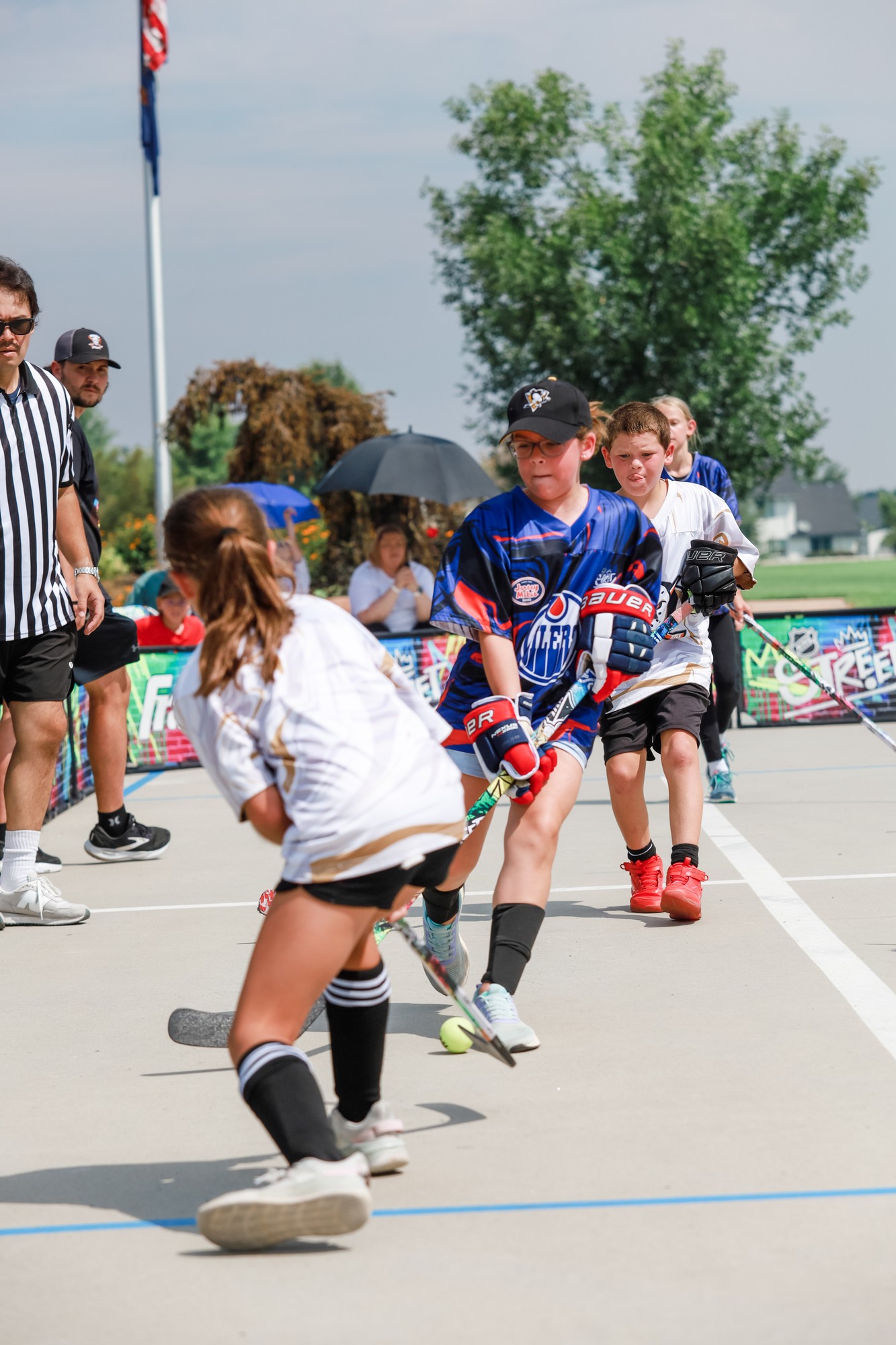
Because players aren’t skating, street hockey emphasizes stick skills, awareness, conditioning, and decision-making more than speed on blades. Players must rely on positioning, anticipation, and teamwork rather than raw skating ability. This makes it an incredible development tool not only for beginners, but also for experienced hockey players looking to sharpen their hands and hockey IQ.
One of the biggest advantages of street hockey is accessibility.
Traditional ice hockey can be expensive and logistically challenging, requiring rink availability, costly equipment, and significant time commitments. Street hockey removes many of those barriers. With minimal gear and flexible playing spaces, more kids can participate, more often. That accessibility allows players from all backgrounds to experience the game, build confidence, and develop a love for hockey without the pressure of high costs or early specialization.

Street hockey is also where creativity thrives.
Without boards, ice, or constant stoppages, the game flows quickly and rewards imagination. Players learn to protect the ball, read passing lanes, adapt to different surfaces, and think one step ahead. Many elite hockey players grew up playing street or ball hockey because it teaches instincts that directly translate to ice hockey—quick hands, deception, vision, and resilience.
Importantly, street hockey is not “less than” ice hockey.
It is its own established sport with organized leagues, tournaments, national programs, and international competition. It can stand alone as a lifelong sport, while also serving as a powerful entry point or supplement to ice and roller hockey. Many players use street hockey to stay sharp year-round, build conditioning, and maintain a competitive edge when ice time is limited.

From a developmental standpoint, street hockey teaches more than just athletic skills.
Players learn accountability, teamwork, communication, and respect. Because the game is fast and physically demanding, effort matters. Players quickly understand that success isn’t handed out—it’s earned through hustle, preparation, and smart play. Those lessons extend far beyond the court and into everyday life.
Street hockey is raw, energetic, and community-driven.
It brings the game back to where it started—neighborhoods, driveways, schoolyards, and open courts—while maintaining the structure and integrity of organized sport. It’s hockey stripped down to what truly matters: effort, skill, and heart.
That’s street hockey. And for many players, it’s where the love for the game begins—and never leaves.